top of page


LEBEN

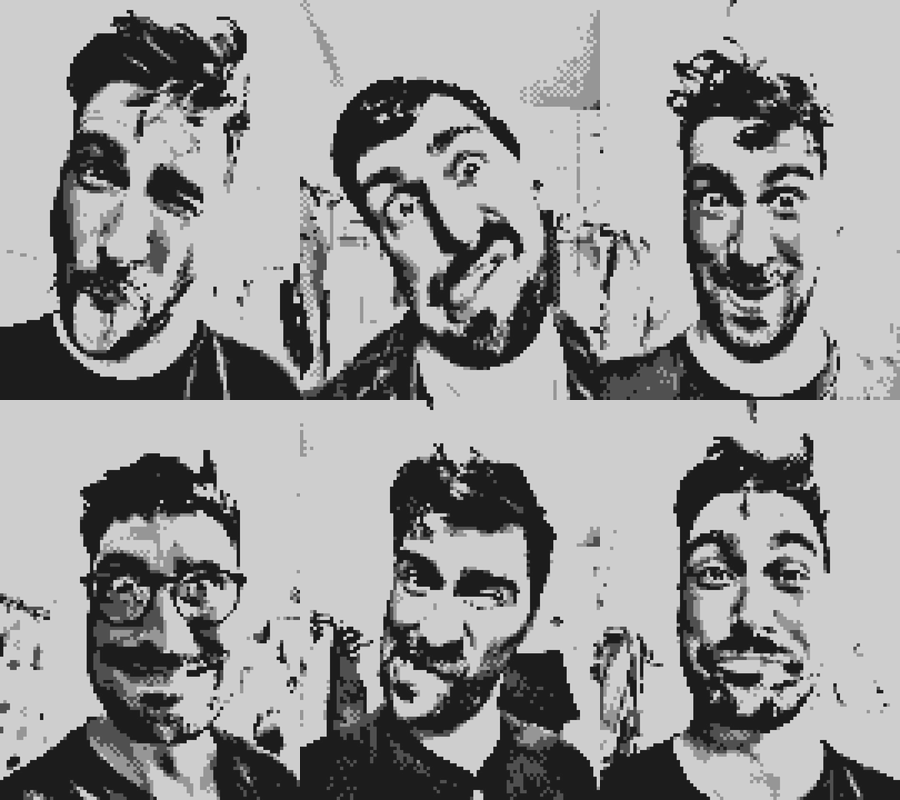

My artistic journey began with monsters drawn in primary school, continued with graffiti as I immersed myself in skateboard and hip-hop culture, and found formal grounding when I chose fine arts as my Abitur subject. Despite plans to teach art, my path turned toward environmental sciences — a Masters in data science and geoinformatics that led me into research and consulting.
When the work drained me, I returned to making. Not to acrylics or spray paint, but to code. I began writing scripts that processed images in ways I couldn't achieve by hand: averaging hundreds of photographs into a single composite, projecting elevation data as LEGO bricks, casting computed shadows across historical survey maps.
The tools I use are ones I built. Each series begins with a piece of software — a pipeline of algorithms that determines what the work can become. The code is not a means to an end; it is part of the artistic practice. The images that emerge are physically printed on cotton-rag paper. The pipeline that produces them lives in a repository. Both are the work.
None of it is AI-generated — no prompts, no models. Every image is the direct result of code written, run, and refined by hand.

INSPIRATION
My earliest inspiration was the older brother of one of my kindergarten friends, who occasionally babysat my brothers and me. He was a very talented sketch artist, listening to heavy metal and playing Dungeons and Dragons, which made him draw amazingly detailed fantasy characters like dwarves, wizards or dragons as gifts for us, while my brother and I watched him in awe. Throughout my teens, I found inspiration in the vibrant world of graffiti. The dynamic 3D styles of DAIM and the character-rich creations of WON captivated me early on, shaping my artistic sensibilities. Today, my admiration extends to the likes of MOSES and TAPS, the daring 1UP crew, and the eclectic collective Rocco und seine Brüder and, of course, Banksy.
My formal art studies at Gymnasium further enriched my palette, drawing influences from Impressionism, Expressionism, Surrealism, and Art Nouveau. The masterpieces of J. M. W. Turner, Claude Monet, Vincent van Gogh, and Alphonse Mucha wove themselves into the fabric of my artistic identity. The lens of Ansel Adams' photography also found a special place in my creative vision.


PHILOSOPHIE

I kept asking what makes something art. The answer I landed on: an image becomes art when it does more than show its subject — when it triggers a feeling or a memory in whoever's looking. The viewer completes the work.
That also means there's no good or bad art, only art that resonates with many or with few. Mine has one purpose: to affirm. I want to spark curiosity and wonder — and if a piece makes someone smile, it worked.
bottom of page